The Geometry of Egusi & Yam: Notes on West African Soup Architecture
Why the tactile memory of pounded yam dictates the viscosity of slow-toasted melon seeds, and how Canterbury hearth cooking honors ancient Nigerian coastal technique.
Words by Chef Olu
Photography by Amara Mensah • In-house Culinary Archive
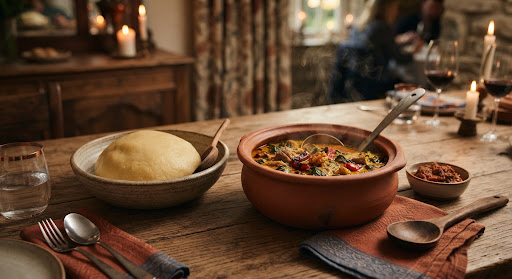
Stoneware vessel of slow-simmered toasted egusi melon seed stew, tempered with native smoked crayfish and crushed Kentish bitter leaves, served with hand-pounded yam.
Burgate Archive • Oct 202401. The Emulsion of Melon Seed
There is a structural fallacy in European culinary lexicon that renders any liquid-forward dish under the umbrella of "soup." To describe Egusi as a soup is to misapprehend its physics entirely. In West Africa, particularly along the humid agricultural belts stretching inland from Lagos through Ondo and into the heart of Igboland, egusi is an architecture of suspension.
It begins not with stock cubes or roux, but with the seed of the wild indigenous melon (Citrullus lanatus). When gently dry-toasted over seasoned hardwood coals, the seed releases its dormant linoleic oils without scorch. Ground slowly between granite stones, the paste forms an unctuous, velvety emulsion capable of absorbing intense broth, dry-smoked river fish, and fermented seeds without ever splitting.
Unlike European stocks that rely on heavy butter mountings or gelatinous animal reductions for body, the egusi seed offers its own natural proteins and fats. It creates curds resembling soft scrambled custard or delicate cloud-like pillows that cradle the greens and the pungent notes of iru—the fermented locust bean that acts as our deep-bass harmonic chord.
“A soup in West Africa is not a precursor to dining; it is the entire landscape of the table, anchored by the starch that translates its heat.”
02. Sourcing in East Kent
When establishing our hearth in Canterbury on Burgate, the instinctive critique was distance: how does one manifest coastal West African culinary integrity within the garden basin of East Kent?
The answer lies not in substitution, but in dialogue. We bring uncompromised dried ingredients from generational cooperatives in Ibadan—sun-cured locust beans, sun-dried scotch bonnets with their fierce stone-fruit aroma, and wild-grown ground melon seeds. Yet the vegetable mantle finds its soul in our surrounding Kentish orchards and organic patch farms outside Chartham.
Where waterleaf or bitterleaf would reign in Calabar, we harvest late-season frost-sweetened Kentish winter greens, cavolo nero, and delicate buttercup squash. The dense starch profile of cold-climate squash mimics the sweet creaminess of coastal plantain, yielding a velvety depth that balances the relentless sting of slow-roasted red habaneros.

Chef Olu tending the hearth embers at 10C Burgate before the evening sitting window begins.
03. The Etiquette of Swallowing
Pounded yam—iyan—is neither side dish nor bread. It is an instrument of transport and an embodiment of community rhythm. Produced by pounding boiled white yams in heavy mortar vessels until the cellulose ruptures into an elastic, snow-white mound, its texture must be immaculate: zero grains, silky yet possessing structural tension.
At an Ola Hola table, we invite guests to bypass the distance of silver cutlery. To partake in egusi and iyan with the right hand is to engage in a physical communion. You pinch a morsel of warm yam, roll it gently against the palm with the thumb into an indentation—a natural ladle—and press it through the egusi mound, capturing both seed curd and charred leaf before drawing it inward.
It is known across Yoruba traditions as "swallow" because it is designed to slip smoothly past the palate, carrying the rich heat of the pepper stew into the chest, wrapping the diner in an immediate, grounding calm.
04. Canterbury Table Presence & Wine Notes
In our Canterbury dining room, we match this complex savory profile with low-intervention natural skin-contact wines and low-tannin chilled reds from neighboring Kentish hills. The subtle minerality of local chalk soil cuts cleanly through the egusi seed lipids, cleansing the palate between each swallow while honoring the heat.
Hospitality is never just feeding; it is the pacing of presence. When this pot arrives at your table, steam drifting under low amber lights while Afro-cuban jazz spins softly on vinyl, the distance between Lagos and East Kent collapses into a single, shared warmth.
Taste Chef Olu's Egusi Stew & Pounded Yam at 10C Burgate
Featured on our current evening dining roster. Served with stone-pounded yam, slow-smoked salt-cured fish, or seasonal ember-roasted Kentish roots for plant-led diners.
Related Dispatches

The 33⅓ RPM Sanctuary: Selecting Highlife & Dub for Dinner
How our analog sound corner pairs West African horn lines and Caribbean dub rhythms with the progression of evening dining courses.
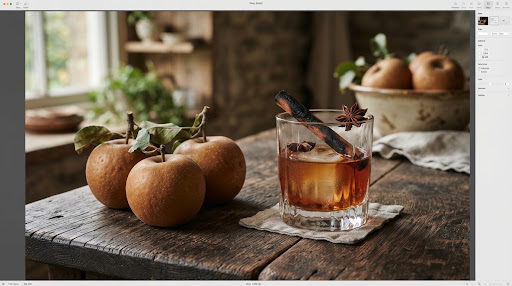
Kentish Apples Meet Barbados Rum: An Orchard Infusion
Bridging Canterbury's cider lineage with small-batch Caribbean pot-still rums, steeped over smoked vanilla bean and charred orange peel.